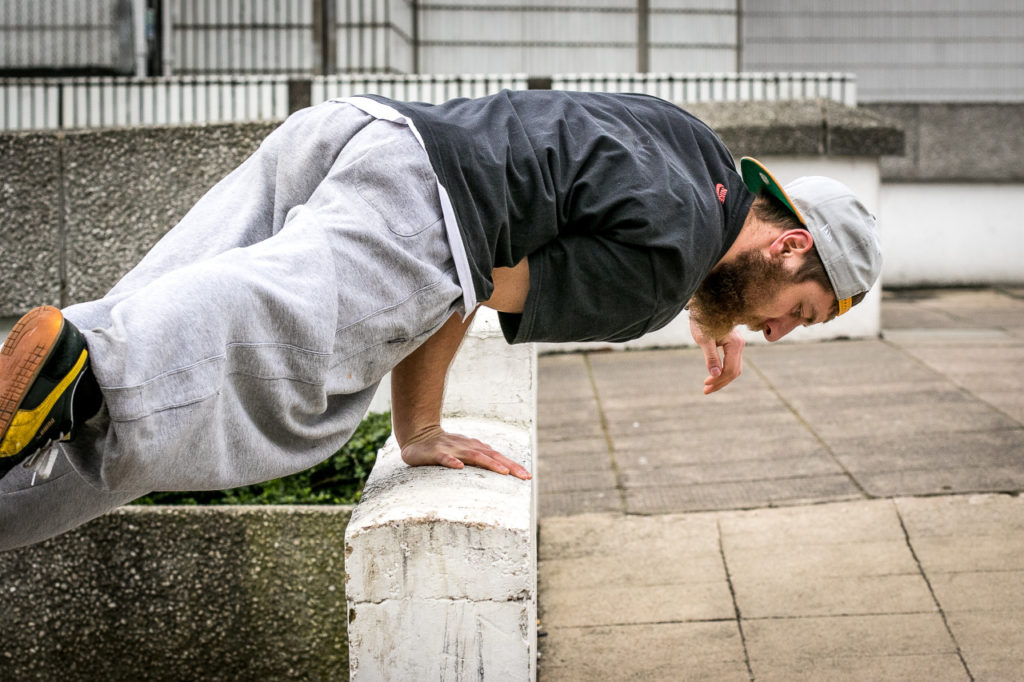
One of parkour’s best features is its kit list. After twenty years of outdoor training in Sheffield weather, here’s our complete, unabridged guide to what you need – and the surprisingly long list of what you don’t.
The entire kit list
- Trainers with decent grip
- Clothes you can move in
- A spare layer (this is Sheffield)
- Water
That’s it. Total cost of starting parkour: whatever’s already in your wardrobe.
Shoes: the only thing worth thinking about
Grip is everything. You want trainers with a grippy rubber sole, reasonably flat, that fit snugly – running shoes with huge foam heels aren’t ideal, but almost any ordinary trainer will do to start. Don’t buy special “parkour shoes” for your first sessions; work out what you like by training first. Your first pair will get scuffed – that’s a feature, not a fault.
Clothes: whatever you can move in
Joggers or shorts and a t-shirt – anything that doesn’t restrict a deep squat or a big reach. For Sheffield’s climate, layers beat one heavy coat: you’ll warm up fast once you’re moving and want to shed a layer, not sweat inside it. Something you don’t mind getting dusty against a wall is wise.
What you don’t need
- Gloves – bare hands read the surface; grip feedback is a safety feature
- Expensive kit – nothing about parkour improves with price tags
- Protective pads – proper progression is the protection; you learn control, not collision
- A gym membership – the city is free and open all hours
Winter training
Sessions run year-round, and winter training is genuinely good – quieter spots, sharper focus. Add a hat and a warm layer for breaks, and respect wet surfaces: grip changes completely in the rain, and knowing when not to jump is the most important skill in the discipline.
To start with, yes – they’re better than nothing and most people’s first sessions happen in them. Their thick foam heels blunt the ground feel you’ll eventually want for precise landings, so if you stick with it you’ll probably drift towards something flatter. Let training tell you when.
Almost no experienced practitioner wears them. Your palms toughen quickly, and the feedback bare skin gives you about a surface – wet, gritty, crumbling – is safety information you don’t want filtered through fabric.
No – the checklist above is the whole thing. Here’s exactly what happens at your first session, and here’s when and where to come.
That’s the whole guide. Trainers, joggers, water bottle – and a Thursday session to wear them to. Questions? The FAQ has you covered.


Leave a Reply